






As global vehicle exports and cross-border automotive trade continue to surge, efficient vehicle logistics have become the backbone of the international automotive supply chain. Whether you are an automobile exporter moving brand-new EVs from manufacturing plants, a used car dealer distributing fleet vehicles to regional hubs, or a logistics firm handling domestic distribution, maximizing transit efficiency while minimizing cargo damage is paramount.A specialized car carrier trailer (also widely known as a car transport trailer or car hauler trailer) offers the most cost-effective, secure, and high-capacity solution for moving multiple vehicles over long distances. Compared to driving vehicles individually—which incurs prohibitive labor expenses, high fuel consumption, and unnecessary wear and tear—a dedicated car carrier semi trailer optimizes every square meter of road space.
This comprehensive guide serves as an authoritative pillar resource for fleet managers, sourcing agents, and logistics operators looking to understand the technical architecture, variant types, and strategic purchasing considerations of commercial car carriers.
Get Quotations!
Contact ushat Is a Car Carrier Trailer?
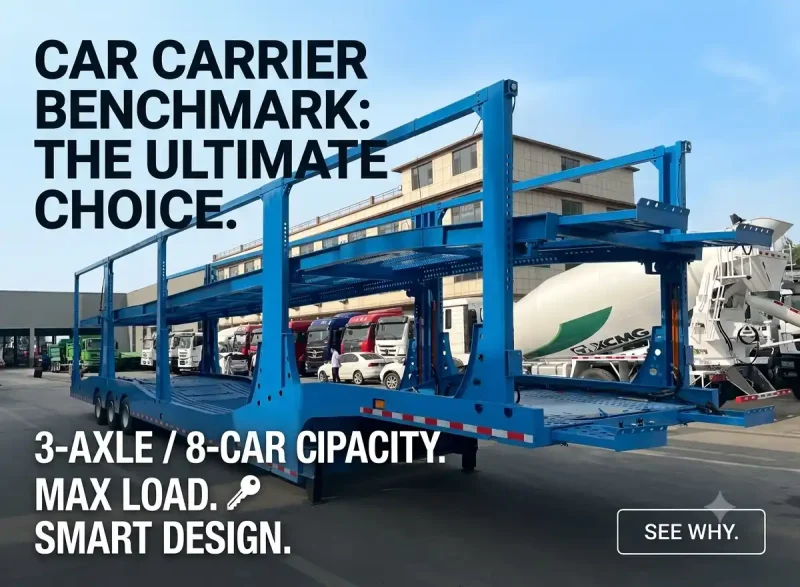
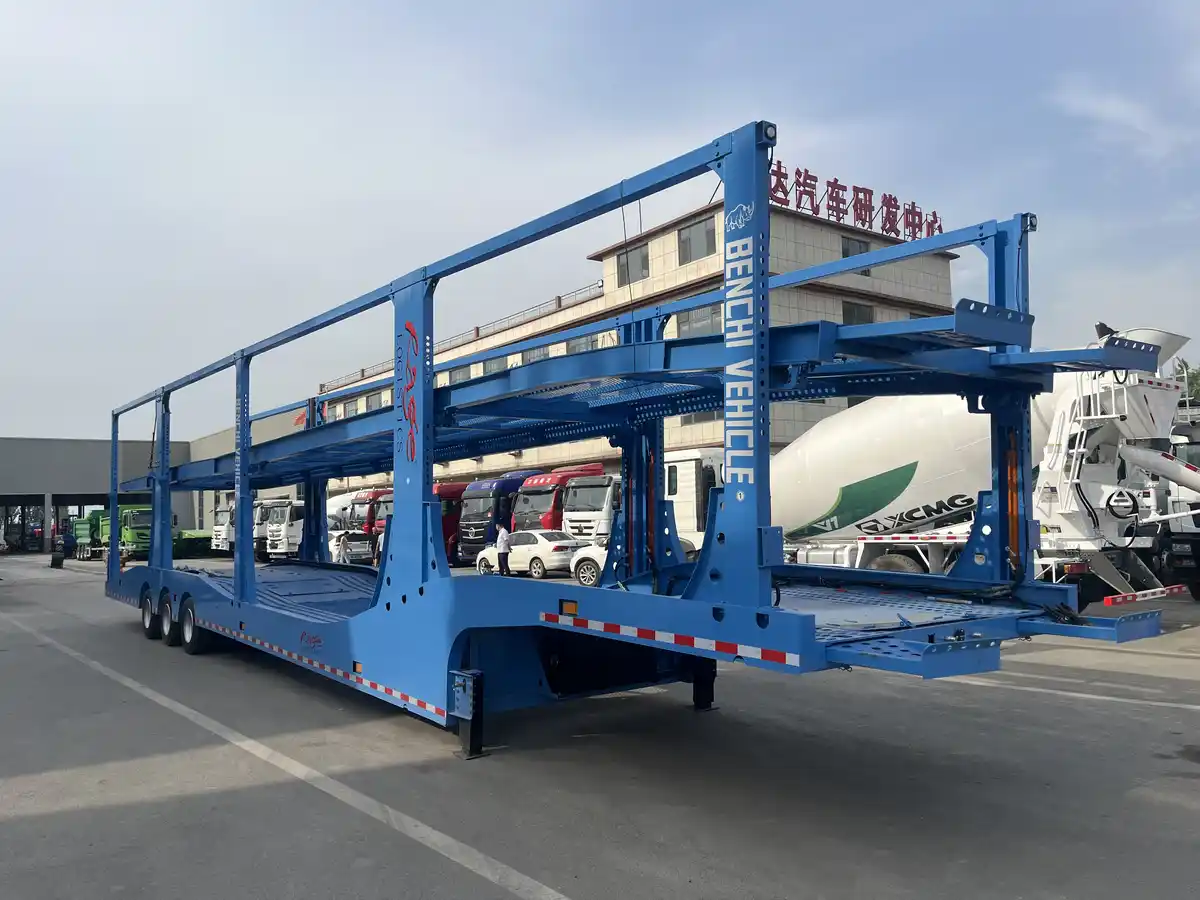
A car carrier trailer is a highly engineered, multi-tier commercial semi-trailer specifically designed to secure and transport passenger cars, SUVs, pickups, and light commercial vehicles simultaneously.
Unlike conventional flatbed or low-bed trailers that rely on flat surfaces and standard tie-down straps, a modern vehicle transport trailer integrates advanced structural and mechanical systems to maximize vertical space while maintaining strict road clearance compliance.
+-------------------------------------------------------------+
|  [Upper Deck]   O==O        O==O        O==O        O==O    |  <- Hydraulic Adjustable
+-------------------------------------------------------------+
|  [Lower Deck]       O==O        O==O        O==O            |  <- Fixed/Low-Clearance
+-------------------------------------------------------------+
Core Engineering Features:
-
Double-Deck Loading Configurations: Utilizing both an upper and lower deck to double the cargo capacity within a standard tractor-trailer footprint.
-
Hydraulic Lifting Mechanisms: Heavy-duty hydraulic cylinders and arms that lift, lower, and tilt sections of the upper deck to facilitate seamless loading and optimal nesting of vehicles.
-
Punch-Hole Anti-Slip Ramps: Specialized driving tracks with perforated, raised patterns that provide maximum tire traction for loading vehicles safely under all weather conditions.
-
Wheel-Chock Securing Systems: Standardized perimeter tie-down points paired with professional over-wheel ratchet straps and chocks to isolate vehicles from road vibration and inertia.
Main Types of Car Carrier Trailers
Selecting the right vehicle carrier depends heavily on your cargo profile, budget, transport distance, and environmental exposure risks. As a leading car transport semi trailer manufacturer, Benchi Heavy Industry classifies these trailers into three primary configurations:

1. Standard Double-Deck Car Carrier Trailer
The absolute workhorse of global automotive logistics. This open-frame design features a completely adjustable upper deck supported by robust hydraulic pillars.
-
Typical Capacity: Optimally configured as an 8 car carrier trailer, but scalable from 6 to 10 passenger vehicles depending on vehicle lengths and local axle-load regulations.
-
Best Used For: High-volume regional distribution of standard sedans, crossovers, and compact SUVs by mainstream dealerships and logistical operators.

2. Fully Enclosed Car Carrier Trailer
Engineered as a premium, high-security transport asset, this trailer features rigid or heavy-duty curtain-side walls and a solid roof.
-
Key Advantages: Absolute protection against harsh weather, road debris, dust, industrial fallout, and opportunistic theft or vandalism.
-
Best Used For: Transporting luxury sports cars, classic vintage collections, prototype test vehicles, and high-value electric vehicles (EVs) directly to showrooms or VIP clients.
Get Quotations!
Contact usTypical Technical Specifications
When evaluating a commercial car carrier semi trailer, reviewing precise technical baselines ensures your asset complies with operational demands and international safety standards.
| Structural Component | Industrial Standard Specification | Benchi Heavy-Duty Heavy-Duty Configuration |
| Trailer Dimensions | 13,500mm–16,000mm × 2,550mm × 3,800mm | Customized based on regional road compliance |
| Axle Configuration | 2-Axle or 3-Axle setup | 3-Axle heavy-duty low-profile system |
| Nominal Payload Capacity | 20,000 kg to 40,000 kg | Up to 45,000 kg structural limit |
| Axle Brand Options | Standard local brands | FUWA / BPW (13-Ton to 16-Ton variants) |
| Tire Specifications | Standard radial tires | 245/70R17.5 or 11R22.5 high-load low-profile tires |
| Suspension Architecture | Standard leaf spring | Heavy-duty mechanical leaf spring or premium air suspension |
| King Pin Assembly | 2.0-inch standard | JOST interchangeable 2″ (50#) or 3.5″ (90#) |
| Braking Infrastructure | Dual-line pneumatic system | WABCO ABS/EBS emergency valve system |
| Deck Plate Engineering | 3mm plain steel sheet | 5mm high-traction punch-hole channelling |
| Hydraulic Activation | Manual valve control | 4 to 6 Type-160 double-acting hydraulic cylinders |
| Landing Gear | 28-Ton structural capacity | JOST two-speed manual operational landing legs |
Core Structural Components & Manufacturing Quality
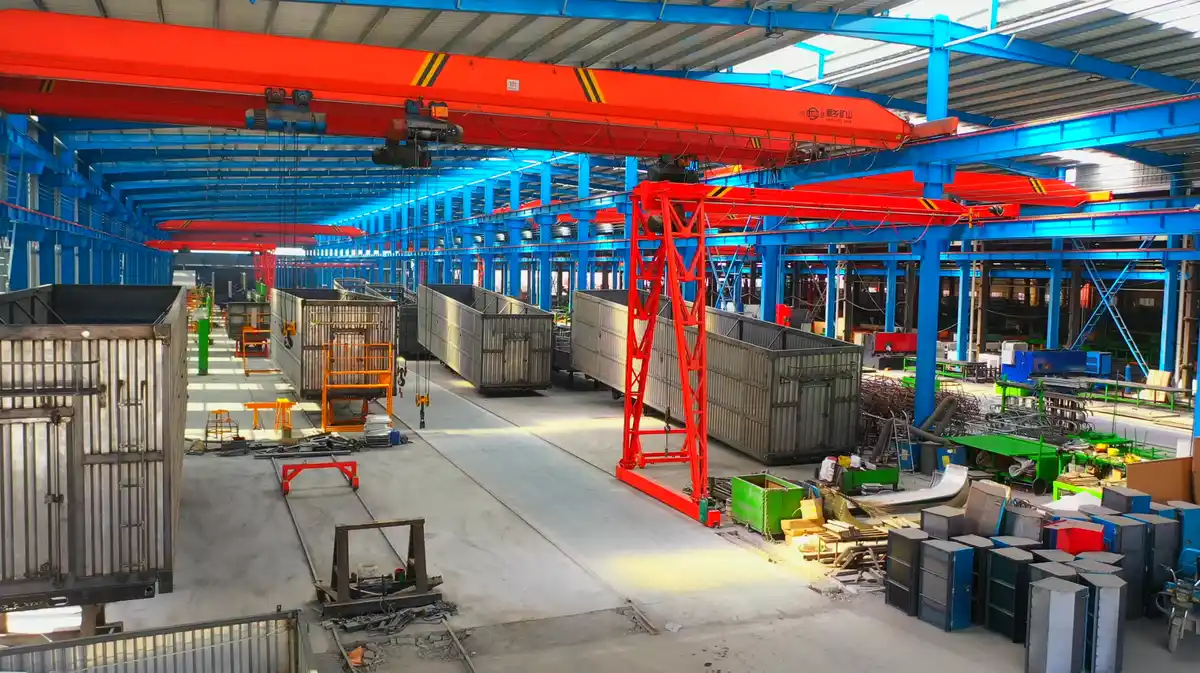
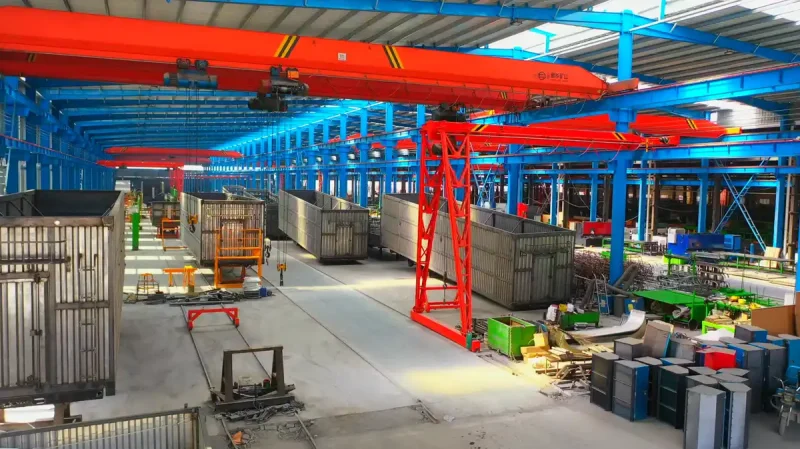
The longevity of a trailer is determined during its manufacturing phase. A premium car transport semi trailer manufacturer like Benchi Heavy Industry utilizes advanced metallurgy and automated production lines to eliminate structural failure points.
1. High-Strength Q355 Steel Main Beams
The skeleton of the trailer must withstand dynamic twisting forces, especially when fully loaded with heavy SUVs or electric vehicles with dense battery packs.
-
We build our main longitudinal beams using premium Q355 high-strength low-alloy steel.
-
Rather than manual welding, beams undergo automatic submerged arc welding under strict quality control, ensuring flawless structural integration, deep weld penetration, and high resistance to fatigue deformation.
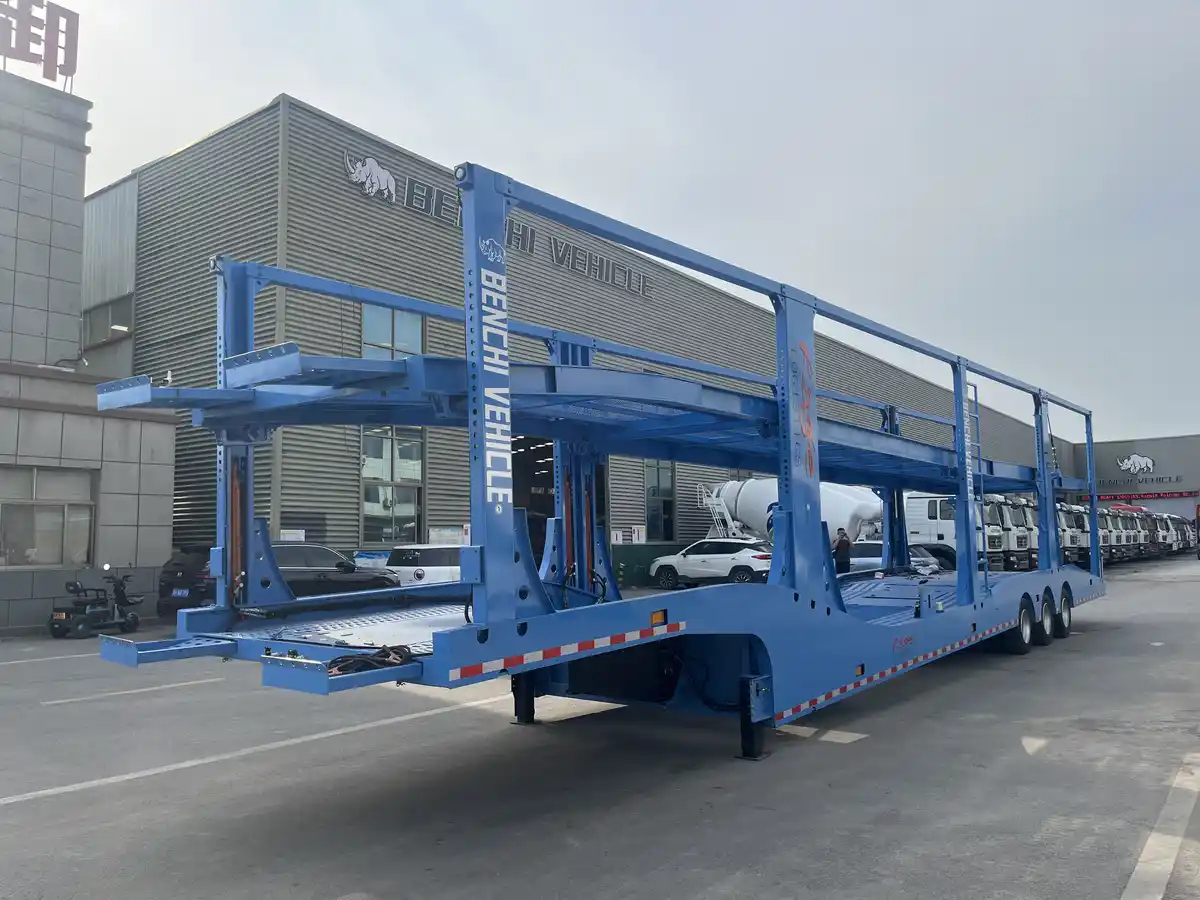
2. Multi-Stage Hydraulic Lifting Platform
The upper deck is driven by high-pressure, synchronized hydraulic cylinders. Benchi integrates:
-
Hard-chrome plated cylinder rods to resist rust and environmental pitting.
-
Mechanical safety lock-bars at multiple height increments. Once the upper deck is lifted to position, mechanical pins take the load off the hydraulic system, preventing accidental deck drops during long-haul transit.


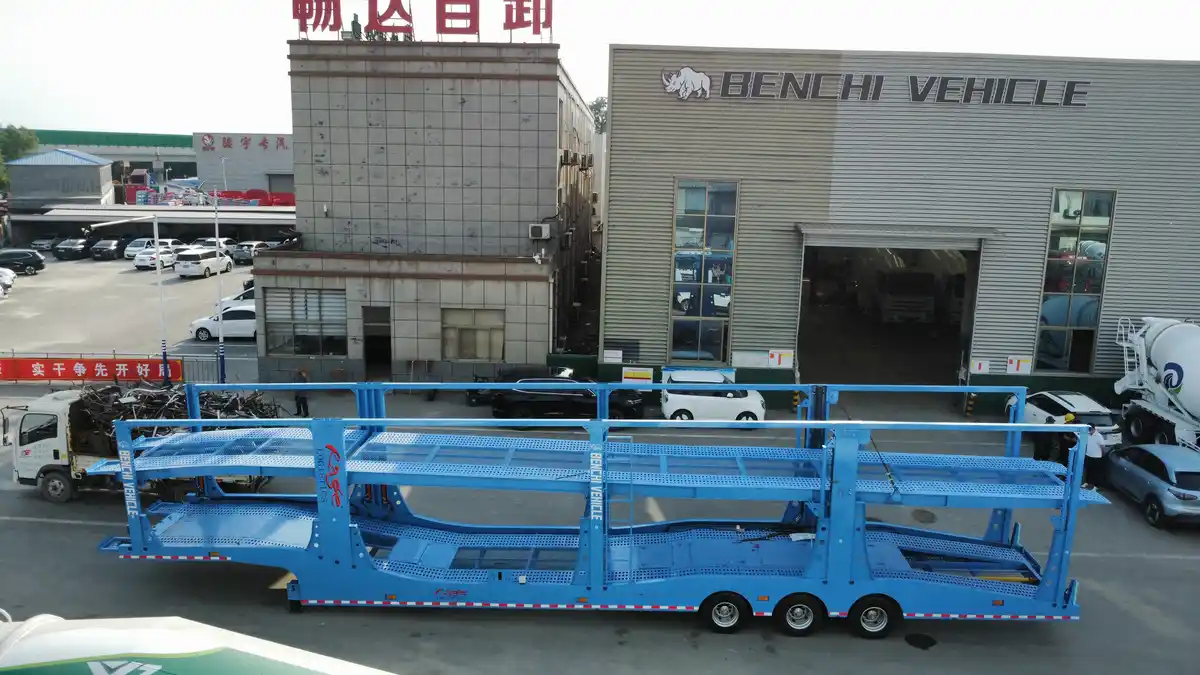
3. Precision Punch-Hole Anti-Slip Decks
The driving tracks feature a signature perforated, raised ridge design. This specific layout serves two critical purposes:
-
Unmatched Traction: Prevents vehicle tires from spinning or slipping while loading in rainy, muddy, or icy conditions.
-
Infinite Tie-Down Adjustability: The punch holes allow customized over-the-wheel ratchet straps and chocks to hook into the frame at exactly the right position, accommodating varying wheelbases without requiring specialized anchor tracks.
Get Quotations!
Contact usUnderstanding Actual Loading Capacity
A common point of confusion for buyers is calculating how many vehicles can legally and physically fit onto a standard trailer. Volume capacity is strictly dictated by the mixed sizing of your cargo profile.
Volumetric Cargo Matrix:
-
Compact/Standard Sedans: An 8 car carrier trailer can typically be optimized to hold up to 8–10 vehicles by angling the upper deck sections to allow car hoods to nest slightly under the trunks of adjacent vehicles.
-
Full-Sized SUVs & Crossovers: Due to increased roof heights and wider track widths, capacity generally adjusts to 6–8 vehicles.
-
Full-Sized Pickups / Light Commercial Trucks: Heavy or long vehicles limit capacity to 5–6 units, utilizing flat configurations on both levels without radical deck angles.
Pro-Tip for Fleet Operators: Always calculate your fleet’s average gross vehicle weight (GVW). Electric vehicles (EVs) are substantially heavier than internal combustion engine (ICE) cars due to their battery arrays. Ensure your trailer’s structural axle rating (e.g., 3 × 13-Ton axles) can comfortably handle the concentrated load of multi-EV shipping.

Optimizing for Rugged Operational Environments: Car Carrier Trailer for Africa
Logistics routes across developing economies—particularly in sub-Saharan African nations like Nigeria, Tanzania, Kenya, Zambia, and Ghana—demand vastly different engineering baselines compared to smooth European or North American highways.
When searching for a dependable car carrier trailer for Africa, off-the-shelf highway models will quickly suffer structural cracks, suspension failures, and rapid tire wear due to:
-
Sustained operations on unpaved gravel, corrugated dirt, and potholed roads.
-
Extremely high ambient operating temperatures accelerating tire blowout risks and hydraulic oil degradation.
-
Long-distance cross-border transit over mountain passes with minimal maintenance or breakdown infrastructure.
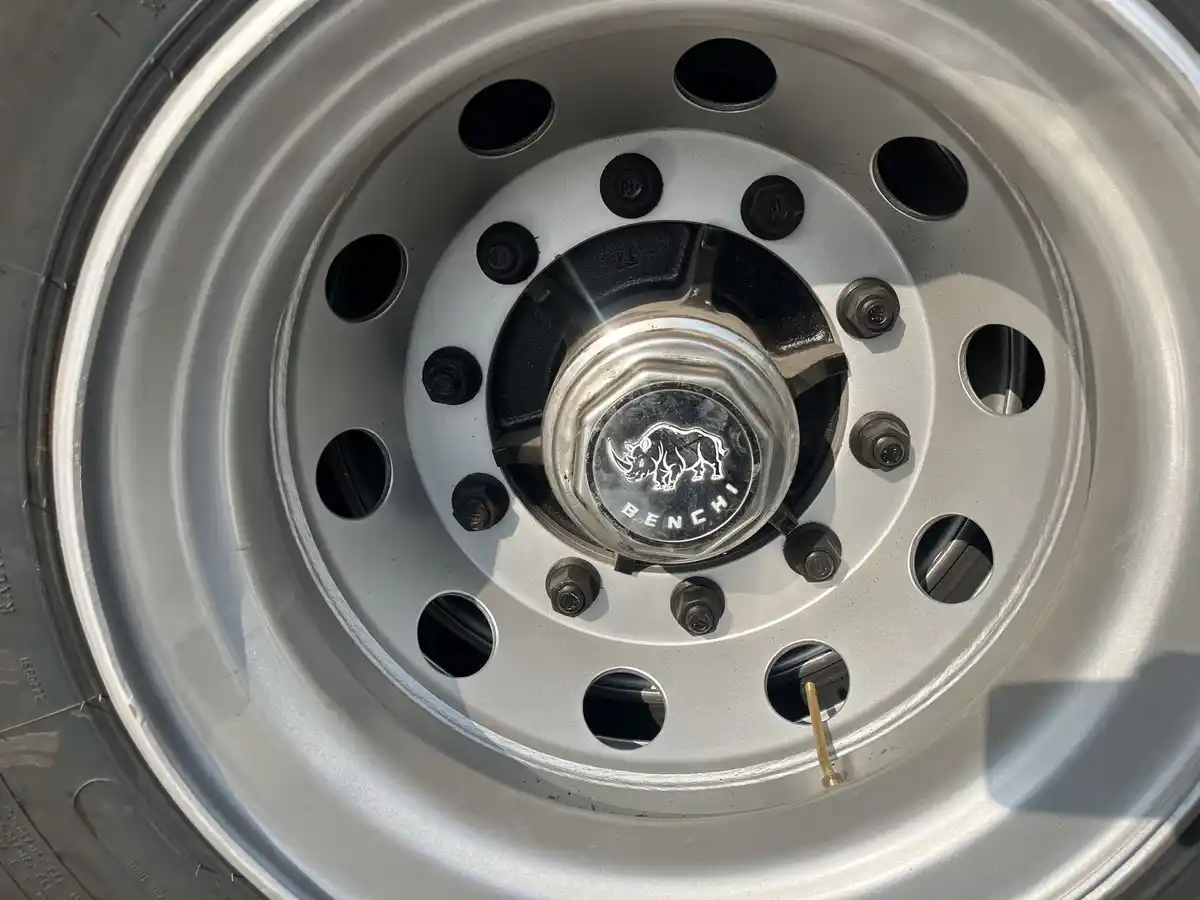
Benchi’s Targeted Engineering Solutions for Tough Terrains:
-
Reinforced Dual-Beam Chassis: Thickened top, middle, and bottom plates on the main chassis beam to isolate structural components from heavy torsional stress.
-
Heavy-Duty Mechanical Suspension: Moving away from sensitive air bags, we implement multi-leaf heavy-duty mechanical spring suspensions utilizing thickened leaves. This ensures maximum load equalization and field-serviceability using standard tools.
-
Oversized Low-Profile Heavy Tires: Incorporating premium steel-belted radial tires with high ply-ratings designed specifically to dissipate heat effectively and resist sharp rock punctures.
-
Dust-Sealed Hydraulic Systems: Upgraded seals on all hydraulic cylinders and robust protective covers for central power units to prevent dust and sand ingress from contaminating valve blocks.
Global Freight Cost Optimization: The Split-Shipment Advantage
One of the biggest financial hurdles for international buyers importing a heavy-duty car carrier semi trailer from China is the astronomical cost of ocean freight. Because these trailers are long and voluminous, shipping them fully assembled via Roll-on/Roll-off (RORO) or conventional breakbulk vessels can sometimes cost almost as much as the trailer itself.
To solve this problem for our international clientele, Benchi Heavy Industry offers a proprietary Split-Shipment / Detachable Structure Design.
[ Factory Production ] -> [ Detachable Upright Posts ] -> [ Flat-Pack / Compact Loading ]
                                                                    ||
[ Drastic Freight Savings ] <- [ Easy On-Site Reassembly ] <- [ Standard Container Shipping ]
How It Works:
-
Modular Engineering: The vertical support posts, upper deck frames, and handrails are engineered with high-precision mechanical interfaces.
-
Containerized Flat-Packing: Instead of shipping a massive 4-meter-tall empty structure, the trailer’s components are nested flatly into standard high-cube shipping containers or tightly stacked onto standard flat racks.
-
Drastic Freight Savings: This modular configuration slashes the overall shipping volume by up to 40% to 60%, allowing multiple units to fit into standard freight channels.
-
Simple On-Site Reassembly: Upon arrival at your destination port or yard, your local mechanical team can easily align the precision interfaces and complete the structural welds/bolt-ups following our step-by-step technical blueprints and video guides.

Frequently Asked Questions (FAQ)
Q1: Can a standard car carrier trailer transport electric vehicles (EVs)?
Yes. However, because EVs are significantly heavier than standard combustion vehicles due to their large battery packs, you must monitor your overall gross axle weight ratings. Benchi recommends specifying upgraded 16-Ton axles and reinforced chassis options if your primary cargo consists of modern EVs.
Q2: Is mechanical suspension or air suspension better for a car hauler?
It depends entirely on your regional road infrastructure. Air suspension offers a much smoother ride, reducing road vibration transferred to the vehicles being carried, making it the choice for high-end highway networks. However, mechanical suspension is heavily favored for markets across Africa and South America due to its extreme ruggedness, low maintenance, and simple repair requirements on rough roads.
Q3: What is the normal lifespan of a Benchi car carrier trailer?
With routine maintenance (such as greasing pivot pins, inspecting hydraulic fluid levels, and maintaining proper tire inflation), a high-quality trailer constructed from Q355 steel will comfortably deliver an operational lifespan of 10 to 15+ years, even under demanding field conditions.
Q4: Can the loading decks be custom-configured for mixed fleets (e.g., sedans and high-roof vans)?
Yes. Our engineering department specializes in tailoring the spacing, hydraulic stroke length, and deck profiling to match your specific fleet profiles. We can integrate deeper wheel wells or extended hydraulic clearances to allow seamless mixed loading of high-roof passenger vans and standard compact cars on a single trip.
Conclusion
Investing in a commercial-grade car carrier trailer is a highly effective way to scale up your automotive logistics business, slash long-haul transport overheads, and guarantee safe vehicle deliveries. From the structural integrity of Q355 high-strength steel main beams to cost-saving split-shipment designs engineered for global transit, selecting a trailer optimized for your operational environment is key to maximizing your return on investment.
As an experienced international car transport semi trailer manufacturer, Benchi Heavy Industry builds field-tested, high-performance transport equipment engineered specifically to handle the most demanding road conditions across Africa, the Middle East, and beyond. Contact our engineering consultancy team today to request a detailed technical blueprint, configure an asset tailored to your fleet requirements, or obtain a comprehensive factory-direct pricing quote.
Get Quotations!
Contact us